# GraphGen
**Repository Path**: tize/GraphGen
## Basic Information
- **Project Name**: GraphGen
- **Description**: No description available
- **Primary Language**: Unknown
- **License**: Apache-2.0
- **Default Branch**: main
- **Homepage**: None
- **GVP Project**: No
## Statistics
- **Stars**: 0
- **Forks**: 0
- **Created**: 2026-02-05
- **Last Updated**: 2026-05-30
## Categories & Tags
**Categories**: Uncategorized
**Tags**: None
## README

[](https://github.com/open-sciencelab/GraphGen)
[](https://github.com/open-sciencelab/GraphGen)
[](https://github.com/open-sciencelab/GraphGen/issues)
[](https://github.com/open-sciencelab/GraphGen/issues)
[](https://chenzihong.gitbook.io/graphgen-cookbook/)
[](https://pypi.org/project/graphg/)
[](https://cdn.vansin.top/internlm/dou.jpg)
[](https://arxiv.org/abs/2505.20416)
[](https://huggingface.co/papers/2505.20416)
[](https://huggingface.co/spaces/chenzihong/GraphGen)
[](https://modelscope.cn/studios/chenzihong/GraphGen)
GraphGen: Enhancing Supervised Fine-Tuning for LLMs with Knowledge-Driven Synthetic Data Generation
[English](README.md) | [中文](README_zh.md)
📚 Table of Contents
- 📝 [What is GraphGen?](#-what-is-graphgen)
- 📌 [Latest Updates](#-latest-updates)
- ⚙️ [Support List](#-support-list)
- 🚀 [Quick Start](#-quick-start)
- 🏗️ [System Architecture](#-system-architecture)
- 🍀 [Acknowledgements](#-acknowledgements)
- 📚 [Citation](#-citation)
- 📜 [License](#-license)
- 📅 [Star History](#-star-history)
[//]: # (- 🌟 [Key Features](#-key-features))
[//]: # (- 💰 [Cost Analysis](#-cost-analysis))
[//]: # (- ⚙️ [Configurations](#-configurations))
## 📝 What is GraphGen?
GraphGen is a framework for synthetic data generation guided by knowledge graphs. Please check the [**paper**](https://arxiv.org/abs/2505.20416) and [best practice](https://github.com/open-sciencelab/GraphGen/issues/17).
It begins by constructing a fine-grained knowledge graph from the source text,then identifies knowledge gaps in LLMs using the expected calibration error metric, prioritizing the generation of QA pairs that target high-value, long-tail knowledge.
Furthermore, GraphGen incorporates multi-hop neighborhood sampling to capture complex relational information and employs style-controlled generation to diversify the resulting QA data.
After data generation, you can use [LLaMA-Factory](https://github.com/hiyouga/LLaMA-Factory) and [xtuner](https://github.com/InternLM/xtuner) to finetune your LLMs.
## 📌 Latest Updates
- 🎉 **2026.04.13**: The paper based on GraphGen, *Knowledge-to-Verification: Exploring RLVR for LLMs in Knowledge-Intensive Domains*, has been accepted to the **ACL 2026** Main Conference! Congratulations! [[arXiv](https://arxiv.org/abs/2605.18261)][[Code](https://github.com/SeedScientist/K2V)]
- **2026.02.04**: We support HuggingFace Datasets as input data source for data generation now.
- **2026.01.15**: **LLM benchmark synthesis** now supports single/multiple-choice & fill-in-the-blank & true-or-false—ideal for education 🌟🌟
History
- **2025.12.26**: Knowledge graph evaluation metrics about accuracy (entity/relation), consistency (conflict detection), structural robustness (noise, connectivity, degree distribution)
- **2025.12.16**: Added [rocksdb](https://github.com/facebook/rocksdb) for key-value storage backend and [kuzudb](https://github.com/kuzudb/kuzu) for graph database backend support.
- **2025.12.16**: Added [vllm](https://github.com/vllm-project/vllm) for local inference backend support.
- **2025.12.16**: Refactored the data generation pipeline using [ray](https://github.com/ray-project/ray) to improve the efficiency of distributed execution and resource management.
- **2025.12.1**: Added search support for [NCBI](https://www.ncbi.nlm.nih.gov/) and [RNAcentral](https://rnacentral.org/) databases, enabling extraction of DNA and RNA data from these bioinformatics databases.
- **2025.10.30**: We support several new LLM clients and inference backends including [Ollama_client](https://github.com/open-sciencelab/GraphGen/blob/main/graphgen/models/llm/api/ollama_client.py), [http_client](https://github.com/open-sciencelab/GraphGen/blob/main/graphgen/models/llm/api/http_client.py), [HuggingFace Transformers](https://github.com/open-sciencelab/GraphGen/blob/main/graphgen/models/llm/local/hf_wrapper.py) and [SGLang](https://github.com/open-sciencelab/GraphGen/blob/main/graphgen/models/llm/local/sglang_wrapper.py).
- **2025.10.23**: We support VQA(Visual Question Answering) data generation now. Run script: `bash scripts/generate/generate_vqa.sh`.
- **2025.10.21**: We support PDF as input format for data generation now via [MinerU](https://github.com/opendatalab/MinerU).
- **2025.09.29**: We auto-update gradio demo on [Hugging Face](https://huggingface.co/spaces/chenzihong/GraphGen) and [ModelScope](https://modelscope.cn/studios/chenzihong/GraphGen).
- **2025.08.14**: We have added support for community detection in knowledge graphs using the Leiden algorithm, enabling the synthesis of Chain-of-Thought (CoT) data.
- **2025.07.31**: We have added Google, Bing, Wikipedia, and UniProt as search back-ends.
- **2025.04.21**: We have released the initial version of GraphGen.
## Effectiveness of GraphGen
### Pretrain
Inspired by Kimi-K2's [technical report](https://arxiv.org/pdf/2507.20534) (Improving Token Utility with Rephrasing) and ByteDance Seed's [Reformulation for Pretraining Data Augmentation](https://arxiv.org/abs/2502.04235) (MGA framework), GraphGen added a **rephrase pipeline** — using LLM-driven reformulation to generate diverse variants of the same corpus instead of redundant repetition.
**Setup:** Qwen3-0.6B trained from scratch on [SlimPajama-6B](https://huggingface.co/datasets/DKYoon/SlimPajama-6B).
| Method | [ARC-E](https://allenai.org/data/arc) | [ARC-C](https://allenai.org/data/arc) | [HellaSwag](https://rowanzellers.com/hellaswag/) | [GSM8K](https://github.com/openai/grade-school-math) | [TruthfulQA-MC1](https://github.com/sylinrl/TruthfulQA) | [TruthfulQA-MC2](https://github.com/sylinrl/TruthfulQA) | **Average** |
|:---|:---:|:---:|:---:|:---:|:---:|:---:|:---:|
| SlimPajama-6B trained for 2 epochs | 25.55 | 21.08 | 24.48 | 0.08 | 24.36 | 49.90 | 24.24 |
| SlimPajama-6B + Executive-Summary Rephrase trained for 1 epoch | 26.43 | **22.70** | **24.75** | **1.36** | **26.19** | 51.90 | **25.56**(↑1.32) |
| SlimPajama-6B + Cross-Domain Rephrase trained for 1 epoch | **28.79** | 20.22 | 24.46 | 0.00 | 24.97 | **52.41** | 25.14(↑0.9) |
Both rephrase methods lift the average by ~1 point over the baseline with **zero additional data** — all gains come from how the same knowledge is expressed.
### SFT
Here is post-training result which **over 50% SFT data** comes from GraphGen and our data clean pipeline.
| Domain | Dataset | Ours | Qwen2.5-7B-Instruct (baseline) |
|:---------:|:---------------------------------------------------------:|:--------:|:------------------------------:|
| Plant | [SeedBench](https://github.com/open-sciencelab/SeedBench) | **65.9** | 51.5 |
| Common | [CMMLU](https://github.com/haonan-li/CMMLU) | 73.6 | **75.8** |
| Knowledge | [GPQA-Diamond](https://github.com/idavidrein/gpqa) | **40.0** | 33.3 |
| Math | [AIME24](https://artofproblemsolving.com/wiki/index.php/2024_AIME_I) | **20.6** | 16.7 |
| | [AIME25](https://artofproblemsolving.com/wiki/index.php/2025_AIME_I) | **22.7** | 7.2 |
### RLVR
Reinforcement Learning with Verifiable Rewards (RLVR) has demonstrated promising potential to enhance the reasoning capabilities of large language models (LLMs). However, its applications on knowledge-intensive domains have not been effectively explored due to the scarcity of high-quality verifiable data. By leveraging **GraphGen** for automated verifiable data synthesis, we extend RLVR to these broader domains. We applied reinforcement learning directly to the Qwen2.5-7B base model using the synthesized data without any prior SFT ([Code](https://github.com/superfarther/K2V)). Here are the results.
| Domain | Dataset | Ours | Qwen2.5-7B-Instruct (baseline) |
|:---------:|:---------------------------------------------------------:|:--------:|:------------------------------:|
| Plant | [SeedBench](https://github.com/open-sciencelab/SeedBench) | **66.8** | 51.5 |
| Law | [LawBench](https://github.com/open-compass/LawBench) | **55.2** | 54.76 |
| Medicine | [MedQA](https://github.com/jind11/MedQA) | **87.1** | 80.7 |
| General | [BBH](https://github.com/suzgunmirac/BIG-Bench-Hard) | **55.3** | 49.6 |
More details can be found at [`examples/generate/generate_masked_fill_in_blank_qa`](./examples/generate/generate_masked_fill_in_blank_qa).
## ⚙️ Support List
We support various LLM inference servers, API servers, inference clients, input file formats, data modalities, output data formats, and output data types.
Users can flexibly configure according to the needs of synthetic data.
| Inference Server | Api Server | Inference Client | Data Source | Data Modal | Data Type |
|--------------------------------------------------------------------------|--------------------------------------------------------------------------------|------------------------------------------------------------|---------------------------------------------------------------------------------------------------------------------------------------------------------------------------------------------------------------------------------------------------------------------------------------|---------------|-------------------------------------------------|
| [![hf-icon]HF][hf]
[![sg-icon]SGLang][sg]
[![vllm-icon]vllm][vllm] | [![sif-icon]Silicon][sif]
[![oai-icon]OpenAI][oai]
[![az-icon]Azure][az] | HTTP
[![ol-icon]Ollama][ol]
[![oai-icon]OpenAI][oai] | Files(CSV, JSON, PDF, TXT, etc.)
Databases([![uniprot-icon]UniProt][uniprot], [![ncbi-icon]NCBI][ncbi], [![rnacentral-icon]RNAcentral][rnacentral])
Search Engines([![bing-icon]Bing][bing], [![google-icon]Google][google])
Knowledge Graphs([![wiki-icon]Wikipedia][wiki]) | TEXT
IMAGE | Aggregated
Atomic
CoT
Multi-hop
VQA |
[hf]: https://huggingface.co/docs/transformers/index
[sg]: https://docs.sglang.ai
[vllm]: https://github.com/vllm-project/vllm
[sif]: https://siliconflow.cn
[oai]: https://openai.com
[az]: https://azure.microsoft.com/en-us/services/cognitive-services/openai-service/
[ol]: https://ollama.com
[uniprot]: https://www.uniprot.org/
[ncbi]: https://www.ncbi.nlm.nih.gov/
[rnacentral]: https://rnacentral.org/
[wiki]: https://www.wikipedia.org/
[bing]: https://www.bing.com/
[google]: https://www.google.com
[hf-icon]: https://www.google.com/s2/favicons?domain=https://huggingface.co
[sg-icon]: https://www.google.com/s2/favicons?domain=https://docs.sglang.ai
[vllm-icon]: https://www.google.com/s2/favicons?domain=https://docs.vllm.ai
[sif-icon]: https://www.google.com/s2/favicons?domain=siliconflow.com
[oai-icon]: https://www.google.com/s2/favicons?domain=https://openai.com
[az-icon]: https://www.google.com/s2/favicons?domain=https://azure.microsoft.com
[ol-icon]: https://www.google.com/s2/favicons?domain=https://ollama.com
[uniprot-icon]: https://www.google.com/s2/favicons?domain=https://www.uniprot.org
[ncbi-icon]: https://www.google.com/s2/favicons?domain=https://www.ncbi.nlm.nih.gov/
[rnacentral-icon]: https://www.google.com/s2/favicons?domain=https://rnacentral.org/
[wiki-icon]: https://www.google.com/s2/favicons?domain=https://www.wikipedia.org/
[bing-icon]: https://www.google.com/s2/favicons?domain=https://www.bing.com/
[google-icon]: https://www.google.com/s2/favicons?domain=https://www.google.com
## 🚀 Quick Start
Experience GraphGen Demo through [Huggingface](https://huggingface.co/spaces/chenzihong/GraphGen) or [Modelscope](https://modelscope.cn/studios/chenzihong/GraphGen).
For any questions, please check [FAQ](https://github.com/open-sciencelab/GraphGen/issues/10), open new [issue](https://github.com/open-sciencelab/GraphGen/issues) or join our [wechat group](https://cdn.vansin.top/internlm/dou.jpg) and ask.
### Preparation
1. Install [uv](https://docs.astral.sh/uv/reference/installer/)
```bash
# You could try pipx or pip to install uv when meet network issues, refer the uv doc for more details
curl -LsSf https://astral.sh/uv/install.sh | sh
```
2. Clone the repository
```bash
git clone --depth=1 https://github.com/open-sciencelab/GraphGen
cd GraphGen
```
3. Create a new uv environment
```bash
uv venv --python 3.10
```
4. Configure the dependencies
```bash
uv pip install -r requirements.txt
```
### Run Gradio Demo
```bash
python -m webui.app
```

### Run from PyPI
1. Install GraphGen
```bash
uv pip install graphg
```
2. Run in CLI
```bash
SYNTHESIZER_MODEL=your_synthesizer_model_name \
SYNTHESIZER_BASE_URL=your_base_url_for_synthesizer_model \
SYNTHESIZER_API_KEY=your_api_key_for_synthesizer_model \
TRAINEE_MODEL=your_trainee_model_name \
TRAINEE_BASE_URL=your_base_url_for_trainee_model \
TRAINEE_API_KEY=your_api_key_for_trainee_model \
graphg --output_dir cache
```
### Run from Source
1. Configure the environment
- Create an `.env` file in the root directory
```bash
cp .env.example .env
```
- Set the following environment variables:
```bash
# Tokenizer
TOKENIZER_MODEL=
# LLM
# Support different backends: http_api, openai_api, ollama_api, ollama, huggingface, tgi, sglang, tensorrt
# Synthesizer is the model used to construct KG and generate data
# Trainee is the model used to train with the generated data
# http_api / openai_api
SYNTHESIZER_BACKEND=openai_api
SYNTHESIZER_MODEL=gpt-4o-mini
SYNTHESIZER_BASE_URL=
SYNTHESIZER_API_KEY=
TRAINEE_BACKEND=openai_api
TRAINEE_MODEL=gpt-4o-mini
TRAINEE_BASE_URL=
TRAINEE_API_KEY=
# azure_openai_api
# SYNTHESIZER_BACKEND=azure_openai_api
# The following is the same as your "Deployment name" in Azure
# SYNTHESIZER_MODEL=
# SYNTHESIZER_BASE_URL=https://.openai.azure.com/openai/deployments//chat/completions
# SYNTHESIZER_API_KEY=
# SYNTHESIZER_API_VERSION=
# # ollama_api
# SYNTHESIZER_BACKEND=ollama_api
# SYNTHESIZER_MODEL=gemma3
# SYNTHESIZER_BASE_URL=http://localhost:11434
#
# Note: TRAINEE with ollama_api backend is not supported yet as ollama_api does not support logprobs.
# # huggingface
# SYNTHESIZER_BACKEND=huggingface
# SYNTHESIZER_MODEL=Qwen/Qwen2.5-0.5B-Instruct
#
# TRAINEE_BACKEND=huggingface
# TRAINEE_MODEL=Qwen/Qwen2.5-0.5B-Instruct
# # sglang
# SYNTHESIZER_BACKEND=sglang
# SYNTHESIZER_MODEL=Qwen/Qwen2.5-0.5B-Instruct
# SYNTHESIZER_TP_SIZE=1
# SYNTHESIZER_NUM_GPUS=1
# TRAINEE_BACKEND=sglang
# TRAINEE_MODEL=Qwen/Qwen2.5-0.5B-Instruct
# SYNTHESIZER_TP_SIZE=1
# SYNTHESIZER_NUM_GPUS=1
# # vllm
# SYNTHESIZER_BACKEND=vllm
# SYNTHESIZER_MODEL=Qwen/Qwen2.5-0.5B-Instruct
# SYNTHESIZER_NUM_GPUS=1
# TRAINEE_BACKEND=vllm
# TRAINEE_MODEL=Qwen/Qwen2.5-0.5B-Instruct
# TRAINEE_NUM_GPUS=1
```
2. (Optional) Customize generation parameters in `config.yaml` .
Edit the corresponding YAML file, e.g.:
```yaml
# examples/generate/generate_aggregated_qa/aggregated_config.yaml
global_params:
working_dir: cache
graph_backend: kuzu # graph database backend, support: kuzu, networkx
kv_backend: rocksdb # key-value store backend, support: rocksdb, json_kv
nodes:
- id: read_files # id is unique in the pipeline, and can be referenced by other steps
op_name: read
type: source
dependencies: []
params:
input_path:
- examples/input_examples/jsonl_demo.jsonl # input file path, support json, jsonl, txt, pdf. See examples/input_examples for examples
# additional settings...
```
3. Generate data
Pick the desired format and run the matching script:
| Format | Script to run | Notes |
|-----------------|------------------------------------------------------------------------------|----------------------------------------------------------------------------|
| `cot` | `bash examples/generate/generate_cot_qa/generate_cot.sh` | Chain-of-Thought Q\&A pairs |
| `atomic` | `bash examples/generate/generate_atomic_qa/generate_atomic.sh` | Atomic Q\&A pairs covering basic knowledge |
| `aggregated` | `bash examples/generate/generate_aggregated_qa/generate_aggregated.sh` | Aggregated Q\&A pairs incorporating complex, integrated knowledge |
| `multi-hop` | `examples/generate/generate_multi_hop_qa/generate_multi_hop.sh` | Multi-hop reasoning Q\&A pairs |
| `vqa` | `bash examples/generate/generate_vqa/generate_vqa.sh` | Visual Question Answering pairs combining visual and textual understanding |
| `multi_choice` | `bash examples/generate/generate_multi_choice_qa/generate_multi_choice.sh` | Multiple-choice question-answer pairs |
| `multi_answer` | `bash examples/generate/generate_multi_answer_qa/generate_multi_answer.sh` | Multiple-answer question-answer pairs |
| `fill_in_blank` | `bash examples/generate/generate_fill_in_blank_qa/generate_fill_in_blank.sh` | Fill-in-the-blank question-answer pairs |
| `true_false` | `bash examples/generate/generate_true_false_qa/generate_true_false.sh` | True-or-false question-answer pairs |
4. Get the generated data
```bash
ls cache/output
```
### Run with Docker
1. Build the Docker image
```bash
docker build -t graphgen .
```
2. Run the Docker container
```bash
docker run -p 7860:7860 graphgen
```
## 🏗️ System Architecture
See [analysis](https://deepwiki.com/open-sciencelab/GraphGen) by deepwiki for a technical overview of the GraphGen system, its architecture, and core functionalities.
### Workflow

## 🍀 Acknowledgements
- [SiliconFlow](https://siliconflow.cn) Abundant LLM API, some models are free
- [LightRAG](https://github.com/HKUDS/LightRAG) Simple and efficient graph retrieval solution
- [ROGRAG](https://github.com/tpoisonooo/ROGRAG) A robustly optimized GraphRAG framework
- [DB-GPT](https://github.com/eosphoros-ai/DB-GPT) An AI native data app development framework
## 📚 Citation
If you find this repository useful, please consider citing our work:
```bibtex
@misc{chen2025graphgenenhancingsupervisedfinetuning,
title={GraphGen: Enhancing Supervised Fine-Tuning for LLMs with Knowledge-Driven Synthetic Data Generation},
author={Zihong Chen and Wanli Jiang and Jinzhe Li and Zhonghang Yuan and Huanjun Kong and Wanli Ouyang and Nanqing Dong},
year={2025},
eprint={2505.20416},
archivePrefix={arXiv},
primaryClass={cs.CL},
url={https://arxiv.org/abs/2505.20416},
}
```
## 📜 License
This project is licensed under the [Apache License 2.0](LICENSE).
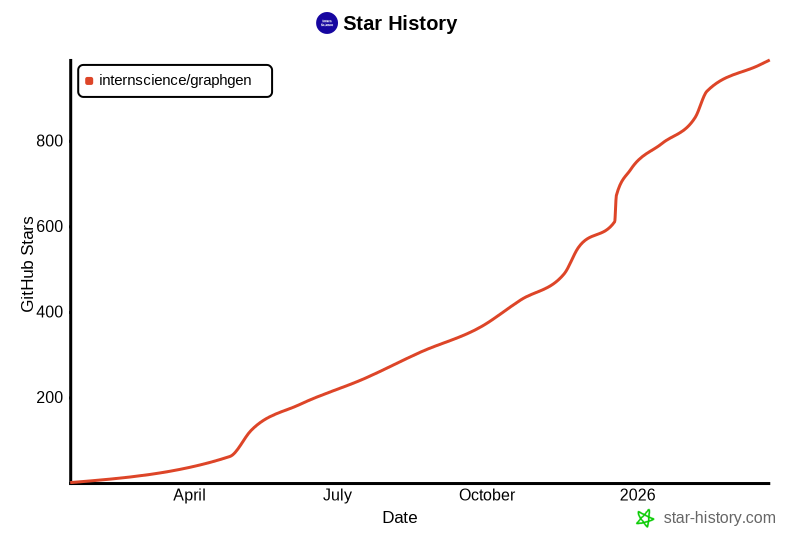
## 📅 Star History
[](https://www.star-history.com/#InternScience/GraphGen&Date)